- 작성일 2026.02.13
- 작성자 고려대학교 세종캠퍼스
- 조회수 5
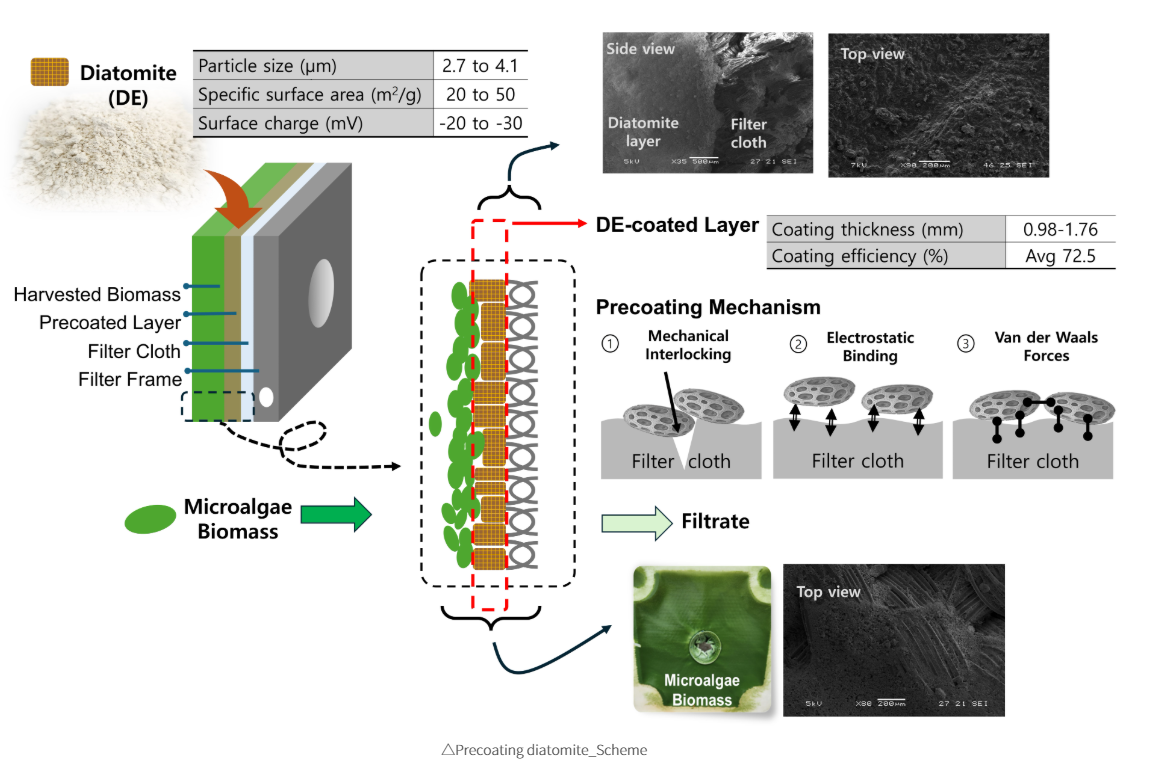
A research team led by Professor Seungpil Baek (corresponding author) of the Department of Biotechnology and Bioinformaticsat Korea University Sejong Campus, together with Dr. Hyojik Yoon (first author) from the Institute of Natural Sciences, has successfully demonstrated energy-efficient, large-scale harvesting of microalgal biomass. The process utilizes a plate and frame filter press pre-coated with diatomite, significantly reducing the energy required for the recovery process.
The research team verified stable performance at harvesting scales of up to 5 tons, thereby demonstrating strong industrial applicability.
The study was published in October 2025 in Bioresource Technology (Impact Factor 9.0, ranked No. 1 in the Agricultural Engineering field) under the title “Diatomite coated plate and frame filter press as novel harvest method of microalgae biomass: Design and pilot-scale study.”
Microalgae are considered next-generation biomass resources due to their high productivity per unit area and significant carbon dioxide reduction potential. However, the harvesting stage—which accounts for a substantial portion of total production costs—has long been regarded as the primary bottleneck to commercialization.
This study presents a method that simultaneously enhances cell capture efficiency and dewatering performance by pre-coating diatomite onto a plate-type filtration system.
The research team validated performance under identical operating conditions at both laboratory and pilot scales. The optimal diatomite pre-coating range was identified as approximately 250–500 mg/L, within which harvesting efficiency increased by 15–20 percentage points.
The filtration cake formed stably, contributing to reduced fouling and sustained permeate flux. Energy consumption was measured at 2.5–3.0 kWh/m³, demonstrating a significant reduction in energy costs compared to conventional centrifugation processes.
The system employed plates with a total filtration area of 1.44 m² and composite filter cloths made of polypropylene, polyethylene, and polyvinyl alcohol (approximately 200 μm thick with 5 μm pore size).
Each filtration cycle consisted of culture injection followed by cake compression. A diatomite layer with an average thickness of 0.85–1.76 mm formed on the filter cloth surface, effectively capturing microalgal cells sized approximately 5–20 μm.
The stability of the coating layer was ensured through physicochemical interactions based on surface charge and microstructure.
Economic evaluation further confirmed the advantages of the proposed method in terms of equipment and energy costs. Diatomite pre-coating filtration has the potential to reduce annual equipment costs to approximately 30% of those associated with centrifugation and membrane filtration, while energy costs can be conservatively reduced to about 80% of existing processes. In addition, a single pre-coating operation enabled continuous operation for 2–3 days, and performance could be maintained through simple re-coating, offering clear benefits in maintenance and operational efficiency.
Professor Seungpil Baek stated, “Diatomite is a naturally derived material with a porous structure and large specific surface area, making it highly effective for capturing fine particles. When pre-coated onto filtration equipment, microalgal cells are collected within the diatomite layer rather than directly clogging the filter pores, allowing stable flux over extended operation periods. This process reduces reliance on synthetic chemical additives while achieving simultaneous harvesting and dewatering, effectively resolving a key bottleneck in the commercialization of microalgae-based biomass.”
This research was supported by the National Research Foundation of Korea through the Carbon to X (CtX) Technology Development Program for Value-Added Material Production and the Regional Leading Research Center (RLRC) Program.