- 작성일 2026.02.13
- 작성자 고려대학교 세종캠퍼스
- 조회수 4
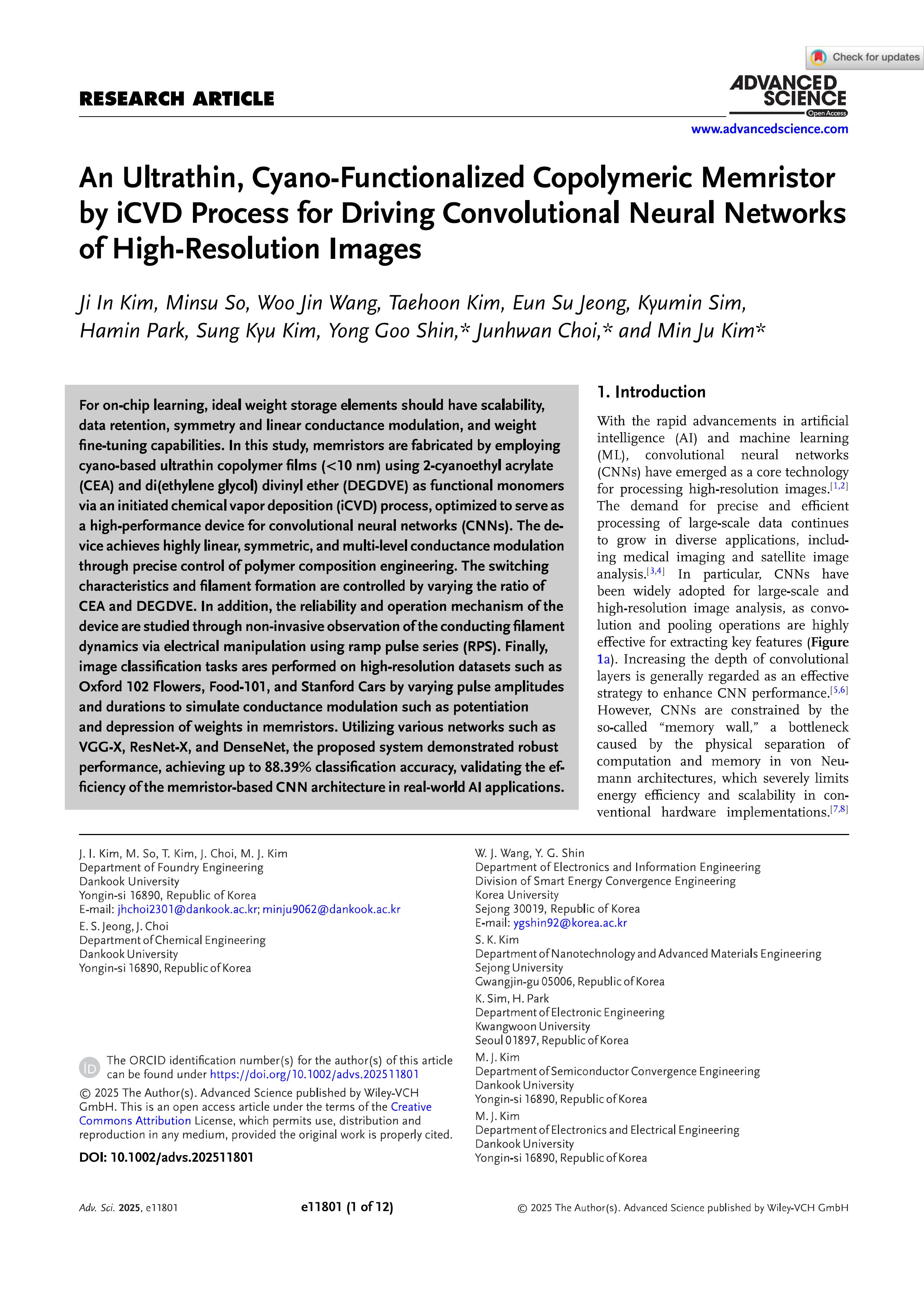
A research team led by Professor Yonggu Shin of the Department of Electronic and Information Engineering at Korea University Sejong Campus has developed a novel material based technology that significantly enhances the performance of memristors key components of next generation artificial intelligence (AI) semiconductors through a collaborative study with Professor Minjoo Kim’s team at Dankook University. By applying an initiated chemical vapor deposition (iCVD) process, the team successfully implemented an organic memristor suitable for high-resolution image processing.
With the rapid expansion of AI technologies, demand for large scale, high resolution image processing has increased sharply. As a result, data bottlenecks and excessive power consumption inherent to conventional computer architectures based on the von Neumann model have emerged as critical technical limitations. In memory computing has been proposed as a promising alternative; however, existing polymer based memristors have faced challenges in commercialization due to device variability and low learning accuracy.
To overcome these limitations, the research team introduced the iCVD process to fabricate memristor devices. Using gaseous phase synthesis of 2 cyanoethyl acrylate (CEA) and diethylene glycol divinyl ether (DEGDVE), the team produced a highly uniform copolymeric thin film with a thickness of less than 10 nanometers. The cyano functional groups in the material enable precise control of conductive filament formation, significantly improving the linearity and symmetry of data storage characteristics.
In addition, the team demonstrated fine control of synaptic weights by applying a driving scheme that adjusts the amplitude and duration of voltage pulses. Simulation of the developed memristor using the DenseNet 121 model achieved classification accuracies of up to 88.39% on high-resolution image datasets, including Oxford 102 Flowers, Food-101, and Stanford Cars. These results surpass existing benchmarks and demonstrate strong potential for practical AI applications.
This research achievement was published in the international journal Advanced Science under the title “An Ultrathin, Cyano-Functionalized Copolymeric Memristor by iCVD Process for Driving Convolutional Neural Networks of High Resolution Images.”
In the interim, Professor Shin is conducting research under the IITP-led Human-Oriented Next Generation Challenging AI Technology Development Program and the National Research Foundation of Korea’s Excellent Young Researcher Program. His work focuses on core technologies for next generation autonomous intelligence systems, including physical AI, generative artificial intelligence, and intelligent agents. The research team continues to advance future oriented AI technologies such as robotic manipulation, multimodal perception, and generative AI integration contributing to the growth of the domestic AI research ecosystem.