- 작성일 2026.02.13
- 작성자 고려대학교 세종캠퍼스
- 조회수 4
Development of a Shape-Recoverable Muscle Regeneration Scaffold Inspired by Mushroom Structure
A Muscle Regenerative Implant That Restores Its Original Shape In Vivo After Injection
A research team led by Professor Hyungjin Lee of the Department of Biotechnology and Bioinformatics Engineering at Korea University Sejong Campus has developed a novel implantable scaffold for muscle regeneration by leveraging the structural and biochemical properties of mushrooms.
Using this scaffold, the team demonstrated the potential for restoring both the structure and function of skeletal muscle damaged by volumetric muscle loss (VML).
This study was conducted through a collaborative effort involving Professor Lee’s team at Korea University Sejong Campus (first author Chanyoung Park, integrated MS PhD program), Professor Geunhyung Kim’s team at the Sungkyunkwan University School of Medicine (first author Hanjun Hwangbo, integrated MS–PhD program), and Dr. Dogeon Yoon’s team at the Hallym University College of Medicine.
The research findings were published online on December 18 in the international materials science journal Advanced Functional Materials under the title “Shape-Recoverable Anisotropic Mushroom-Derived Scaffolds for Skeletal Muscle Regeneration.”
Volumetric muscle loss occurs as a result of severe trauma, tumor resection, or accidents, and existing treatment methods face significant limitations in restoring both the structural integrity and functional performance of damaged skeletal muscle. In particular, fibrotic tissue formation and chronic inflammatory responses at injury sites hinder effective muscle regeneration.
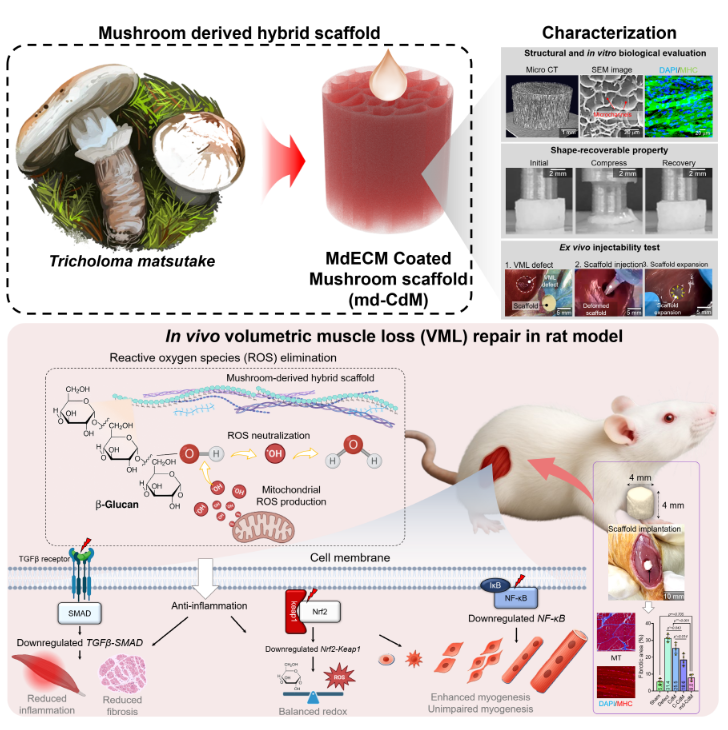
The research team focused on the naturally well-aligned architecture of mushroom stems. Based on this structure, they developed a “shape-recoverable muscle regeneration scaffold” that can be injected via syringe and rapidly restores its original shape inside the body.
The scaffold preserves the anisotropic microchannel architecture of the mushroom while maintaining structural stability even after external compression and injection.
Effective muscle regeneration requires an environment in which regenerative cells can align and differentiate in the same direction as native muscle fibers. To achieve this, the team utilized mushroom derived chitin and beta glucan based components to ensure biocompatibility and structural integrity.
Muscle derived decellularized extracellular matrix (dECM) was further incorporated to provide muscle specific biological cues.
In a rat volumetric muscle loss model, the developed scaffold promoted the regeneration of mature muscle fibers, reduced fibrosis, and improved gait performance and muscle strength. Compared to conventional collagen-based implants, the scaffold demonstrated superior regenerative outcomes.
Additionally, the team identified mechanisms by which mushroom-derived components simultaneously regulate oxidative stress, inflammation, and fibrotic signaling. The scaffold suppressed intracellular reactive oxygen species (ROS) accumulation and downregulated NF-κB and TGF-β/SMAD signaling pathways, thereby creating a microenvironment favorable for muscle regeneration.
Professor Lee stated, “By engineering the structural alignment and biochemical properties of mushrooms, a natural material, we have introduced a regenerative platform capable of inducing simultaneous recovery of muscle structure and function through simple injection.”
This research was supported by Korea University and the National Research Foundation of Korea’s Regional University Outstanding Scientist Support Program (RS-2023-00249119). The research team plans to advance this technology toward minimally invasive muscle regeneration therapy through large-animal studies and validation of clinical applicability.